Conklin Reed Organ Museum
The collection that started it all: nearly 100 restored reed organs and melodeons, and the craftsmanship behind them.
HHAHS began with Lee Conklin’s antique reed organs and grew into a broader effort to preserve the history of the Hanover-Horton area — the instruments, artifacts, buildings, skills and stories entrusted to our care.
Start with the instruments that started it all. Follow the story of a community through its photographs and papers. Walk the grounds at Heritage Park. Or look over a restorer’s shoulder in the workshop where the music is kept alive.
Everything here is cared for by volunteers, and most of it can be seen in person on a seasonal Sunday afternoon.
The collection that started it all: nearly 100 restored reed organs and melodeons, and the craftsmanship behind them.
Photographs, documents, objects and records that preserve everyday life in the Hanover-Horton area.
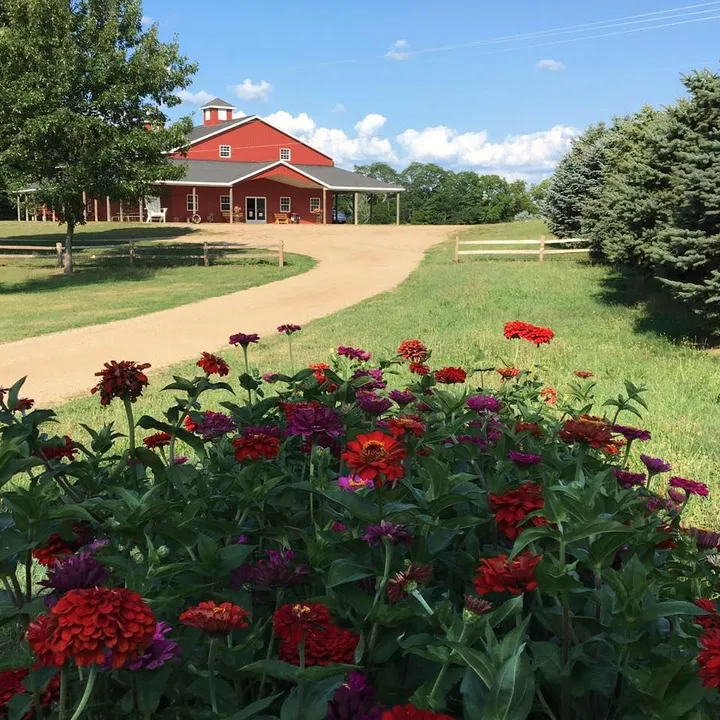
Walking trails, historical demonstration buildings, a working crop farm and the HHAHS Event Center.
The skill and patience it takes to keep antique reed organs playable — plus workshops and ways to help.
Each one comes out of the photographs, records and volunteer knowledge held here in Hanover. More will arrive as the archive is digitized.
Lee Conklin never learned to play the organ, but all his life he enjoyed singing along with one. The 73 reed organs and melodeons he restored in his barn south of Hanover became the museum in December 1977.
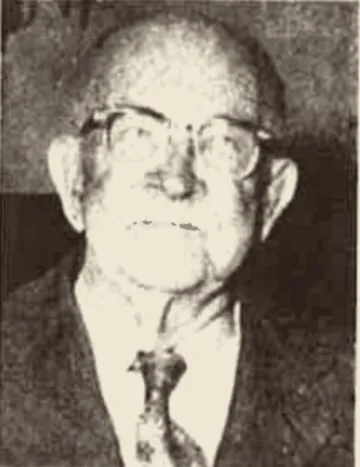
Every museum begins with someone who refused to let something disappear. For the Hanover-Horton area, that someone was Lee Conklin.
He was a farmer and a woodworker. In the years after his wife’s death he collected reed organs and melodeons across Michigan and the Midwest, restored them in the barn on his farm south of Hanover, and donated them to his community.
Lee Conklin was born on January 25, 1895, on a farm in Scipio Township, Hillsdale County, Michigan. His love of music began in childhood, when his sister Grace often played her reed organ for him, his three brothers and another sister.
He never learned to play the organ himself. He did have a fine voice, and all his life he enjoyed singing along with a reed organ.
After training at Camp Custer during World War I, Mr. Conklin returned home and married Grace Gray, a farm girl from Jonesville, Michigan. The couple settled on a farm two miles south of Hanover, where they raised two daughters and four sons.
Besides a lifetime of general farming, he planted his own apple orchard, raised bees, and did custom woodworking with wood from his own sawmill.
His many hobbies included music, wood carving and nature photography. Exploring the rivers of southern Michigan was another favorite pastime. His hand-carved maple canoe paddle is on display in the museum, along with other examples of his handcraft.
After his wife died in 1965, Mr. Conklin renewed his interest in reed organs and melodeons and began to travel extensively through Michigan and the Midwest in search of them. Some were given to him, but most he bought at estate sales and auctions.
As the collection grew, he stored the instruments in the heated, oak-paneled lower level of his barn, which also held a well-equipped woodworking shop. He spent countless hours there cleaning, restoring and refinishing each one, returning it to its original beauty and musical function. Maple, walnut, oak and cherry harvested on his own farm supplied the wood for restoring the cabinets.
Word soon spread, and people from all over the country began coming to Hanover looking for “Lee Conklin’s Organ Barn.” He always gave visitors a warm welcome and enjoyed sharing anecdotes about each instrument.
In the late 1970s Mr. Conklin decided his reed organs and melodeons needed a permanent home, and the perpetual care that he was not able to give them. When he decided in 1977 to leave the farm, a home had to be found for the collection. Local residents were interested in preserving it.
In 1977, the Hanover-Horton Area Historical Society was founded with a single defining purpose: to care for and preserve Mr. Conklin’s remarkable collection of 73 antique reed organs. These were not simply furniture or curiosities. Each instrument carried the music, craftsmanship, and family life of a generation that gathered around the parlor organ the way we gather around screens today.
Arrangements were made for the society to accept the donation of his 73 instruments and a large collection of sheet music, and to lease the empty Hanover High School building to house them. In December 1977 the instruments were moved from the barn to the gymnasium of the old school building, where they remain a permanent exhibit.
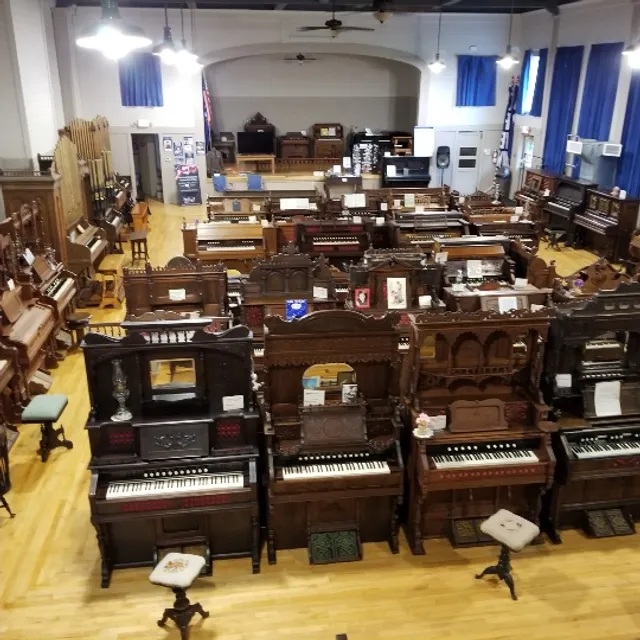
That founding collection became the Conklin Reed Organ Museum. In the years since, more organs have been donated, and it has grown to nearly a hundred organs and melodeons, housed in the historic old Hanover school building on Fairview Street.
Mr. Conklin spent his last years in retirement homes, but he often visited his old organ “friends” in the museum. He kept busy repairing organs, caning chairs for friends and designing craft objects. He remained active and creative to the end of his life and received many honors in his last years.
He died on May 22, 1989, at the age of 94. He is remembered for his gentle, modest ways and for the generous donation of his collections.
The organs remain the heart of HHAHS. Everything the society has grown into — the local history exhibits, Heritage Park, the workshops and community events — grew up around the collection Lee Conklin entrusted to his neighbors.
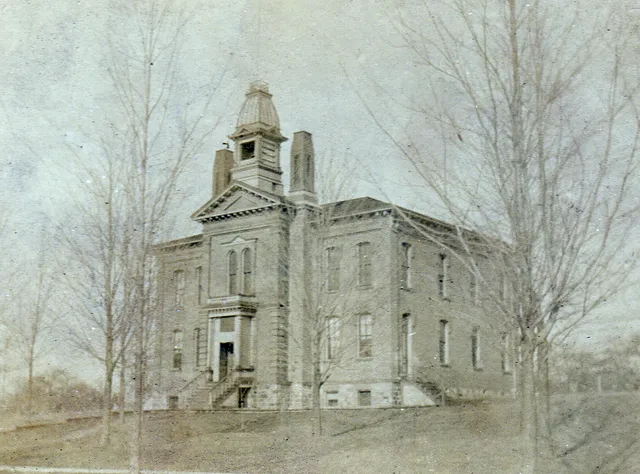
Before it housed nearly a hundred reed organs, the museum building rang with school bells. The old Hanover school is an artifact in its own right.
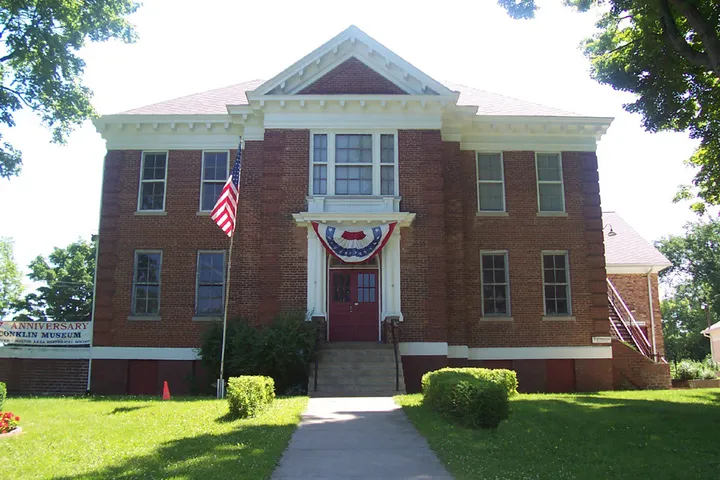
The building at 105 Fairview Street is more than a home for the collection — it is one of the collection’s largest artifacts.
Generations of Hanover students climbed its front steps when it served as the local school. The old Hanover High School was built in 1911 on the site of the original 1874 school. A gymnasium was added in 1934 as a Civil Works Administration relief project, built largely from salvaged local materials.
In 1977 Lee Conklin’s collection of 73 reed organs needed a home. The community organized the Hanover-Horton Area Historical Society, which contracted with the local school system for a 49-year lease on the old school. The Conklin Reed Organ Museum opened in December of that year. The society later purchased the school building and an adjacent school bus garage.
When the society took stewardship of the building, considerable work went into maintaining and restoring it — preserving a landmark that anchors the community’s memory. The old school is a State of Michigan Historic Site, and in December 2012 it was placed on the National Register of Historic Places.
Today the reed organs are displayed in the gymnasium, and five classrooms showcase local history. Among the exhibits is a faithfully restored vintage classroom, named in honor of Zella Gilmore, a long-time teacher in the school. Turn-of-the-century pupil desks, the original teacher’s desk and chair, slates, and a blackboard music lesson bring visitors straight back to a country-school morning.
The room also holds a recitation bench, a dunce stool, schoolbooks, maps and children’s toys. Portraits of Washington and Lincoln, which always hung in classrooms of that period, are there with a 46-star flag, and Mrs. Gilmore’s upright Steinway piano occupies one corner.
The school that once taught Hanover’s children now teaches their grandchildren where they came from.
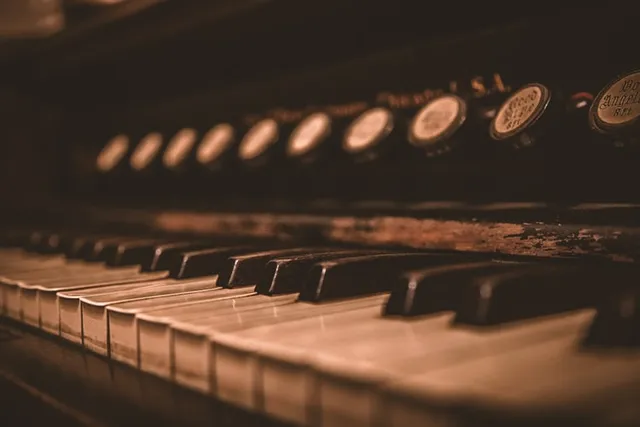
Air, brass reeds, and two pedaling feet. A short introduction to the instrument at the heart of the museum, and the six kinds in the collection.
A reed organ makes music the same way a harmonica does: air moving across a thin brass reed, setting it vibrating. But where a harmonica fits in your pocket, a parlor reed organ fills a room with sound — powered by the player pumping two foot treadles.
Pump the pedals and bellows draw air through the instrument. Press a key and a valve opens, letting air sing through the reed for that note. Pull a stop knob and whole ranks of reeds change the voice of the instrument — soft as a music box or full enough for a church service.
Inside, the air is drawn through a bank of brass reeds. Because the foot pedals work the bellows, these instruments are often called pump organs. Some have a pump handle at the side, so a helper can do the pumping.
The instruments in the collection are all reed instruments, and they fall into six kinds.
In the late 1800s and early 1900s, reed organs were the center of American parlor life, affordable where pianos were not, and hardy enough to travel west in wagons. The Conklin Reed Organ Museum preserves nearly a hundred of them — and thanks to our restoration volunteers, selected instruments can still be heard, not just seen.
More full stories are being written up as volunteers catalog the collection. Newsletter subscribers hear about them first — read past newsletters.
The best way to explore the collection is to stand in the organ hall and hear one played. Visit on a seasonal Sunday afternoon — and help us keep this history playing.