Preserving the stories closest to home
The HHAHS collection reaches well beyond musical instruments. It preserves the people, places, schools, businesses, farms and families that shaped the Hanover-Horton area.
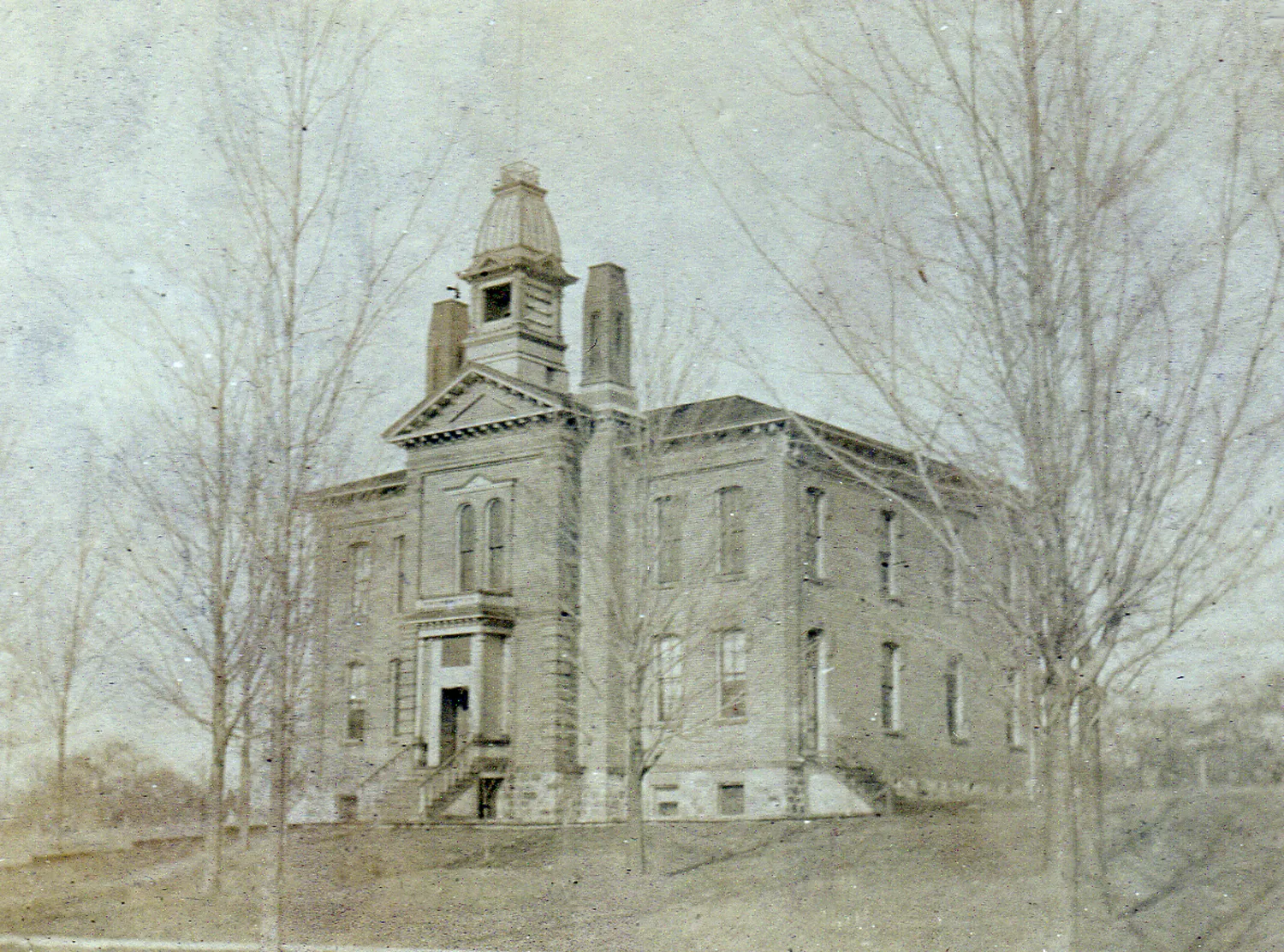
From the society’s archives: the Hanover school in the early 1900s, on the site where the museum stands today.
Everyday life, carefully kept.
Every community keeps its history in ordinary things — a class photograph, a store ledger, a letter home, a tool worn smooth by work. The local history collection gathers photographs, documents, objects and community memories, and holds them where they can be found again. Five classrooms of the old school now showcase it. Among its holdings are Hanover’s original telephone switchboard and the printing press from the local newspaper.
From schoolhouse days to family farms and main-street businesses, these materials tell the everyday story of Hanover-Horton — the story that rarely reaches a textbook, but shapes a place all the same.
Six threads of one community story.
The collection spans the whole fabric of local life. Wherever your curiosity starts, there is a thread to follow.
People & families
The residents, neighbors and family lines whose lives — remembered in photographs and told in stories — built this area.
Schools
School days across the generations, including the old Hanover school itself: the very building that now houses the museum.
Businesses
The shops, trades and working life of the crossroads and main streets that served Hanover and Horton, remembered in the Riske Room of Medicine & Business.
Farms & rural life
The seasons, tools and daily labor of the farms that fed the community and shaped its landscape, with agricultural and hand tools down to a dog-powered treadmill butter churn.
Places
Buildings, landmarks and gathering spots — some still standing, some surviving only in pictures, memory and artifacts from the railroad days and the Stony Point ghost town.
Everyday objects
Household goods, documents and hand-me-downs, including a unique rug loom: ordinary things that turn out to carry extraordinary stories.
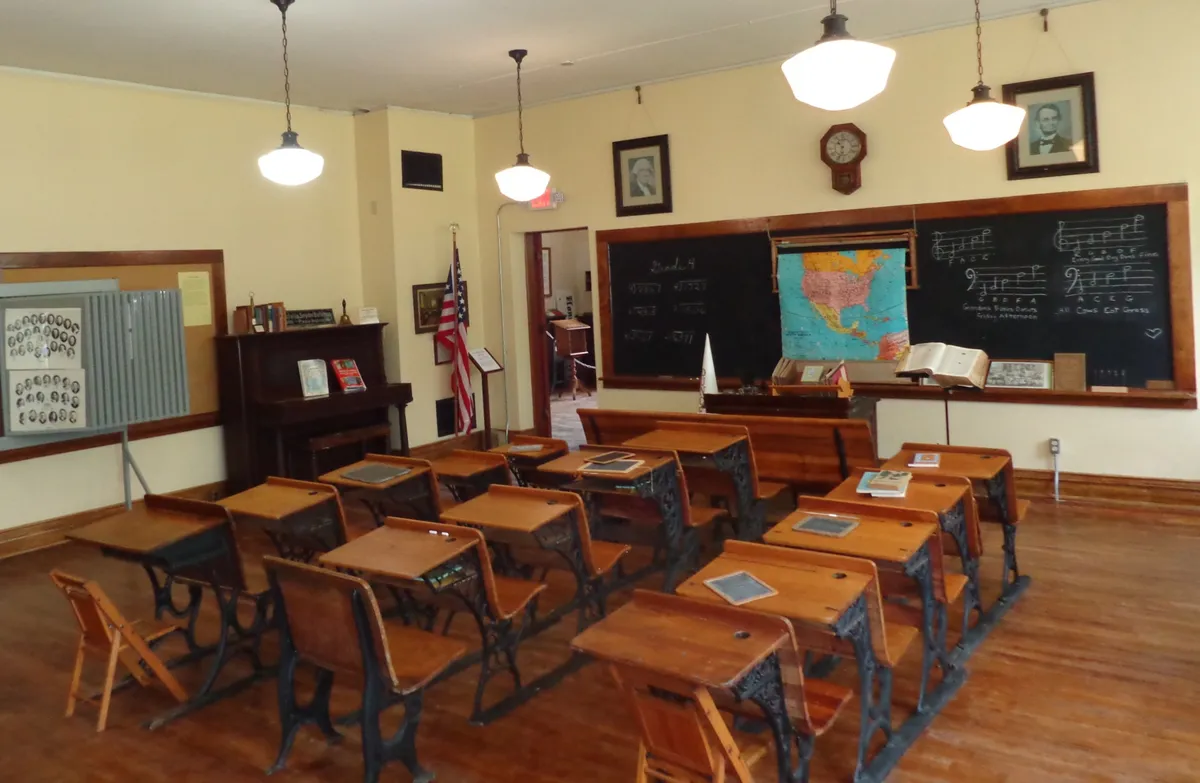
Step into the Zella Gilmore Classroom.
Inside the museum — itself the old Hanover school — a recreated circa-1900 schoolroom brings school days back. It is named in honor of Zella Gilmore, a long-time teacher in the school. Rows of wooden desks face the front of the room much as they did when local students learned their lessons here, surrounded by the books and furnishings of a country education.
It is a favorite stop for visitors of every age, and a reliable conversation starter for anyone who remembers a classroom like it. The museum’s period rooms carry the same feeling through the building, including a 1900s dining room, kitchen and living room.
What is in the room
- Furniture
- Turn-of-the-century pupil desks, the original teacher’s desk and chair, a recitation bench and a dunce stool.
- Lessons and play
- Schoolbooks, slates, maps and children’s toys.
- Portraits
- Washington and Lincoln, whose portraits always hung in the classrooms of that period.
- Flag
- A 46-star flag.
- Piano
- Mrs. Gilmore’s upright Steinway, in one corner of the room.
What the other rooms hold.
The classroom is one stop among several. Here is some of what else the museum has on display.
Getting around the building
The museum’s first floor is wheelchair accessible. The second floor is not.
Questions about access? Call the office at 517-563-8927 (Tuesday–Friday, 9:00 a.m.–12:00 p.m.).
- First floor
Hanover Horton Local press exhibit
On the first floor is an exhibit of items from the Hanover Horton Local, an early mass-produced news publication.
-
Riske Room of Medicine & Business
The Riske Room showcases local businesses and services. There is also a collection of photographs and memorabilia representing the Hanover-Horton area.
- A barber chair
- Local doctors’ equipment
- A postal sorting desk
- A typewriter collection
- Fire-fighting gear
- The Hanover manual telephone switchboard
- Second floor
1900 dining room and kitchen
The second floor hosts many exhibits of local interest. These are three of them, among many other antiques.
- The interior of a typical 1900s household
- Old record-playing machines
- A large handmade rug loom
Access: the second floor is not wheelchair accessible.
- On video
Wayside Inn postcards
The museum has put together a video of postcards from VanSchoick’s Wayside Inn on Round Lake. The postcards are from 1905 to 1925. The Wayside Inn was a very popular turn-of-the-century getaway.
The school is an exhibit too.
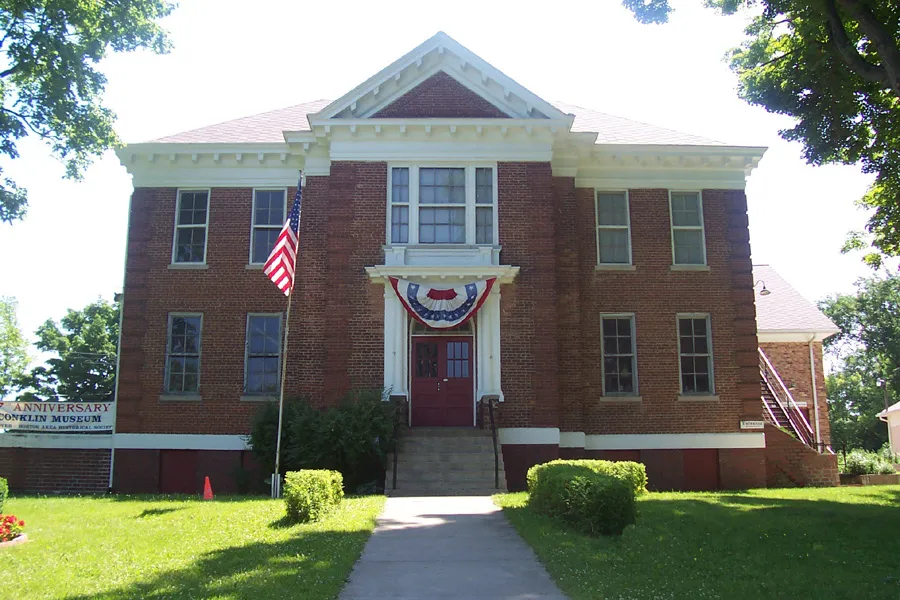
The museum’s home is the old Hanover High School, and the building has a history of its own. Considerable work has gone into maintaining and restoring it.
-
The original school building goes up on this site.
-
The old Hanover High School is built on the original school site. It is the building that houses the museum today.
-
A gymnasium is added to the school as a Civil Works Administration relief project, built largely from salvaged local materials. The reed organs are displayed there now.
-
The newly formed historical society contracts with the local school system to lease the building, and the Conklin Reed Organ Museum opens in December. The society later purchases the school building and an adjacent school bus garage.
-
In December, the building is placed on the National Register of Historic Places. It is also a State of Michigan Historic Site.
A collection still being uncovered.
Volunteers are working through the local history collection — scanning photographs, cataloging records and writing down what people remember before it fades. Featured stories will grow here as that work continues.
In the meantime, curiosity is welcome. If you are wondering about a person, place, family, school or business from the Hanover-Horton area, send the question along. It may even become a future story.
Prefer to talk? Call the office at 517-563-8927 during office hours (Tuesday–Friday, 9:00 a.m.–12:00 p.m.).
Ask a research question
Share what you are curious about. Our volunteer research team follows up as they are able.
Have a piece of Hanover-Horton history?
Family photographs, documents and objects with a local story help this collection grow. The Acquisition Committee reviews potential donations before anything is brought to the museum.